Skip to content
Shandong Yinglang Chemical CO.,LTD
How to Choose Tert-Butyllithium (t-BuLi): A Buyer’s Guide for Safe & Efficient Synthesis
Tert-Butyllithium (t-BuLi), with the CAS number 594-19-4, is widely recognized as one of the most powerful organolithium reagents available. Known for its extreme pyrophoricity and high reactivity, it is the “go-to” reagent for difficult deprotonations and lithium-halogen exchange reactions where n-Butyllithium or s-Butyllithium simply aren’t strong enough.
However, purchasing t-BuLi is not just about finding the lowest price. Because of its hazardous nature and chemical sensitivity, choosing the right specification and supplier is critical for laboratory safety and yield success.
Here are the 4 key factors you must consider when choosing Tert-Butyllithium for your research or industrial production.
Solvent Selection: Pentane vs. Heptane
The most common dilemma buyers face is the choice of solvent. t-BuLi is typically sold as a solution in either Pentane or Heptane (and occasionally Hexane). Which one should you choose?
Pentane (The Standard Choice):
Pros: Low boiling point (36°C). It is very easy to remove under vacuum after the reaction, minimizing solvent residues in your final product.
- Cons: Highly volatile and flammable. In hot climates, internal pressure in containers can rise.
- Best For: Reactions requiring low-temperature workups or where solvent removal is critical.
Heptane (The Safer Alternative):
- Pros: Higher boiling point (98°C). It is less volatile, making it safer to handle and transport, especially during summer months.
Cons: Harder to remove completely from the final product.
Best For: High-temperature reactions or industrial-scale handling where safety is the priority over volatility.
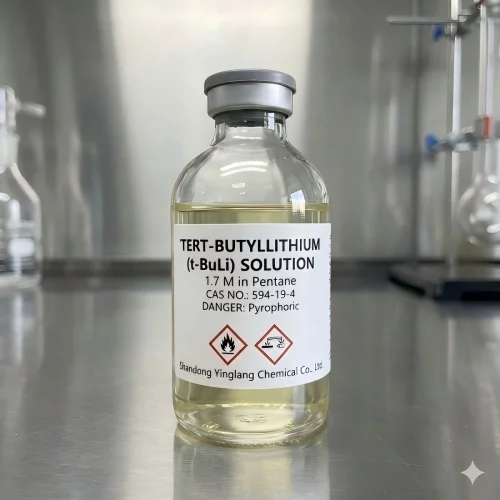
Recommendation: For most R&D synthesis, 1.7M in Pentane is the industry standard. If your lab is in a very hot region or you prioritize transportation safety, ask your supplier for Heptane options.
Concentration: Why 1.7M?
You will typically see Tert-Butyllithium sold at a concentration of 1.7 M (Molar).
- Why not higher? Higher concentrations increase the density of active lithium, which can make the solution dangerously unstable and prone to precipitation at low temperatures.
- Why not lower? Lower concentrations mean you are paying to ship more solvent, increasing logistics costs.
1.6M – 1.7M is the “sweet spot” that balances stability, reactivity, and shipping efficiency. Always check the Certificate of Analysis (COA) to ensure the active lithium content is verified by titration (e.g., usually >10% wt).
Packaging and Seal Integrity (Crucial!)
Since t-BuLi ignites spontaneously upon contact with air, the packaging is not just a container—it is a safety device. When evaluating a supplier, ask about their packaging technology:
Laboratory Scale (100ml – 1L): Look for Sure/Seal™ style bottles with high-quality septa that allow for repeated needle withdrawal without compromising the inert atmosphere (Nitrogen/Argon).
Pilot/Industrial Scale: Ensure the supplier uses specific stainless steel cylinders or Iso-Tanks equipped with standardized dip tubes and valves compatible with air-free transfer lines.
Warning: Never buy t-BuLi from suppliers who use generic packaging. Leaks are not just messy; they are life-threatening.
Freshness and Active Content
Tert-Butyllithium is thermally unstable. Over time, especially if stored improperly, the active “t-BuLi” can degrade into Lithium Hydride (LiH), which is inactive and clouds the solution.
Ask for a recent Date of Manufacture.
Check the Appearance: High-quality t-BuLi should be a clear, colorless to pale yellow liquid. If the solution is dark brown or has heavy precipitate, the quality has degraded.
Supplier Capability: Choose a manufacturer like Shandong Yinglang Chemical that produces fresh batches regularly, rather than a trader holding old stock.
[Contact Us Today for a Quote]
CONTACT US
If you are interested in cooperation, please contact us immediately, we will give you feedback as soon as possible!